Start with the exact claim
“Helps skin feel hydrated,” “reduces the appearance of fine lines,” and “keeps makeup looking fresh” are different promises. One concerns a sensation, one concerns visible appearance, and one concerns how a product wears over time. The most useful evidence depends on what the claim actually says. Before looking at a percentage or a testing badge, identify the product, the claimed effect, and the time frame.
Small wording choices matter. A product that improves the appearance of dry skin is not necessarily changing an underlying skin condition. A result measured immediately after application does not establish that the effect lasts all day. Reading a claim literally helps you avoid giving its supporting test more weight than it can carry.
What laboratory tests can show
Laboratory tests may examine an ingredient, a finished formula, or a product’s physical behavior under controlled conditions. Depending on the method, they might measure how much water a material holds, how a formula spreads, or how it performs on a prepared sample. Controlled tests are useful for comparing formulations and investigating how something works because researchers can limit some of the variation found in everyday use.
Their limitation is equally important: a material in a test vessel is not the same as a finished product used on a person. An ingredient may perform differently depending on its concentration, the rest of the formula, the amount applied, and what happens after rinsing or wear. A lab result can support a narrow statement about what was tested, but it does not automatically prove that every user will notice the same effect.
When a package highlights a laboratory result, ask whether the test involved the ingredient alone or the product you can buy. Also check whether the claimed outcome matches the measurement. Showing that a formula has a particular property is not always the same as showing a visible benefit during an everyday routine.
What tests on people can show
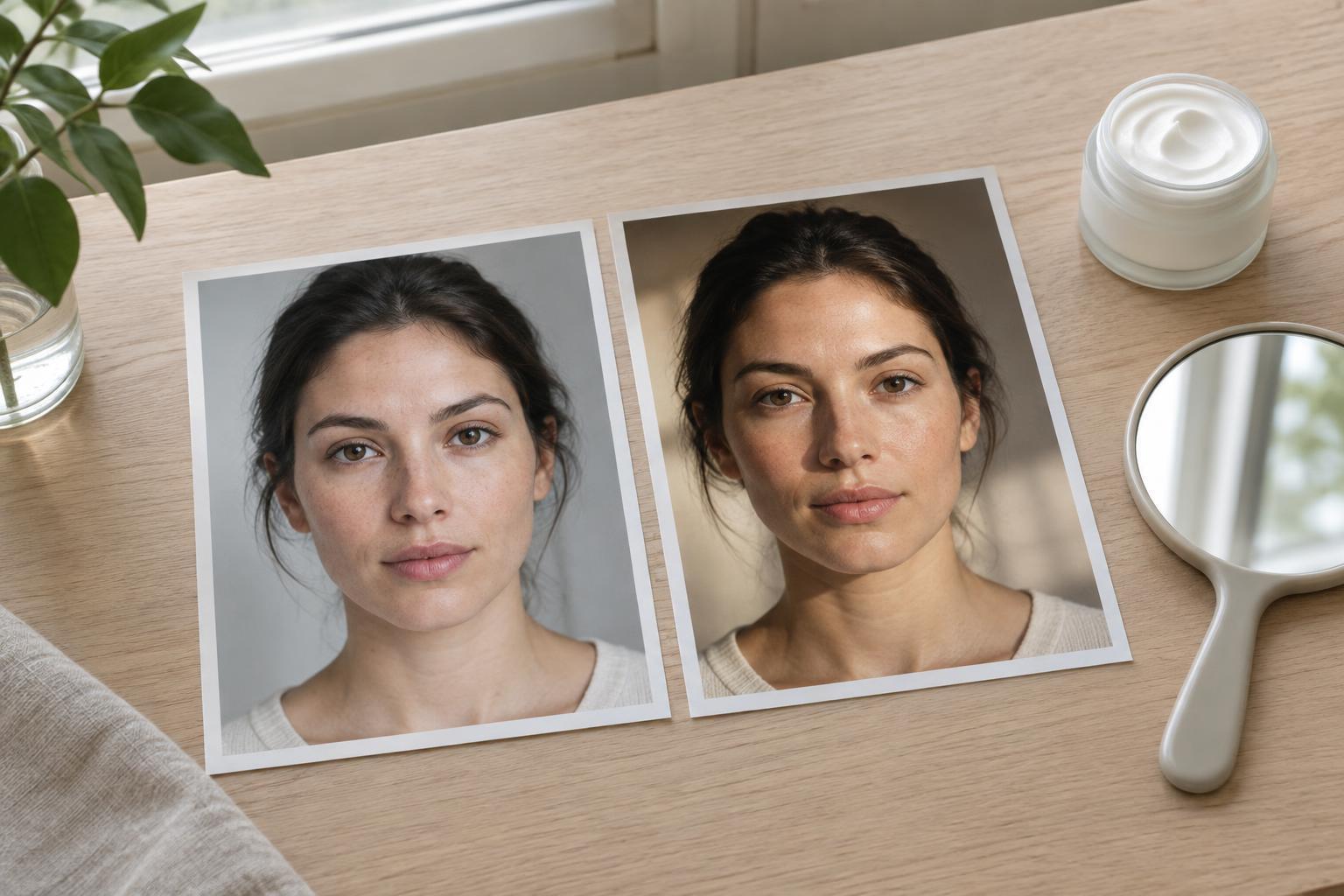
Tests involving volunteers bring the product closer to real use. Participants may apply a finished product for a set period while testers take photographs, make observations, or use instruments to measure a feature of the skin’s surface. Instrumental measurements can add consistency, but they still answer specific questions under specific test conditions. The result may depend on when it was measured, how much product was used, and what other products participants were allowed to use.
Consumer-perception tests ask people what they experienced, such as whether skin felt softer or makeup seemed easier to apply. These responses are relevant when the claim is about feel or satisfaction. They are subjective, however, and expectations can influence answers. A statement such as “most participants agreed” describes the views of the people surveyed; it is not a measurement of how much a product changed everyone’s skin.
Details make these results easier to interpret. Look for the number of participants, the length of use, what they were asked or measured, and whether the reported result reflects all participants or a selected subgroup. A test on people can be informative without being a guarantee of your individual experience.
Read the comparison, not just the percentage
An impressive-sounding result can mean different things depending on its starting point. “Improved hydration by 20%” leaves questions: compared with skin before application, untreated skin, or another product? Was the change measured shortly after use or after repeated use? For a consumer survey, “90% agreed” tells you little until you know the exact statement people agreed with.
A comparison can help separate a product’s effect from ordinary variation, but not every comparison is equally useful. Results from a carefully defined use period are more relevant to a long-wear claim than an immediate reading. An average improvement may also conceal a range of responses. These points do not make a claim meaningless; they show why the headline number should be read alongside the test description.
Use evidence as a guide, not a promise
The strongest match is between the wording of the claim, the product tested, and the outcome measured. For example, a claim about how a moisturizer feels is more directly supported by feedback from users than by a lab test of one isolated ingredient. A claim about a measurable surface effect may benefit from instrumental results as well as observations from people using the finished product. Different methods can complement one another rather than compete.
If testing details are absent, treat a precise-sounding claim with appropriate caution. Consider your own priorities too: a well-supported hydration claim does not tell you whether you will like a product’s texture, scent, or place in your routine. Cosmetic evidence is most helpful when you use it to understand the likely scope of a benefit, then judge whether that benefit is relevant to you.