What cleanser texture can and cannot tell you
Gel, foam, cream and balm describe how a cleanser looks and feels, not exactly how well it cleans. Most cleansers help lift oils, makeup and other material from the skin so they can be rinsed or wiped away. The ingredients that do that work, along with the rest of the formula, matter more than the texture name on the package.
Texture is still a useful starting point. It affects how easily a product spreads, whether it needs water to activate, and how your skin feels after rinsing. A cleanser that leaves your face comfortable and is easy to use consistently may suit you better than one marketed for a particular skin type. Expect some variation within every category: two gels, for example, can have noticeably different amounts of lather and different after-feels.
Gel and foam: light textures with different lather
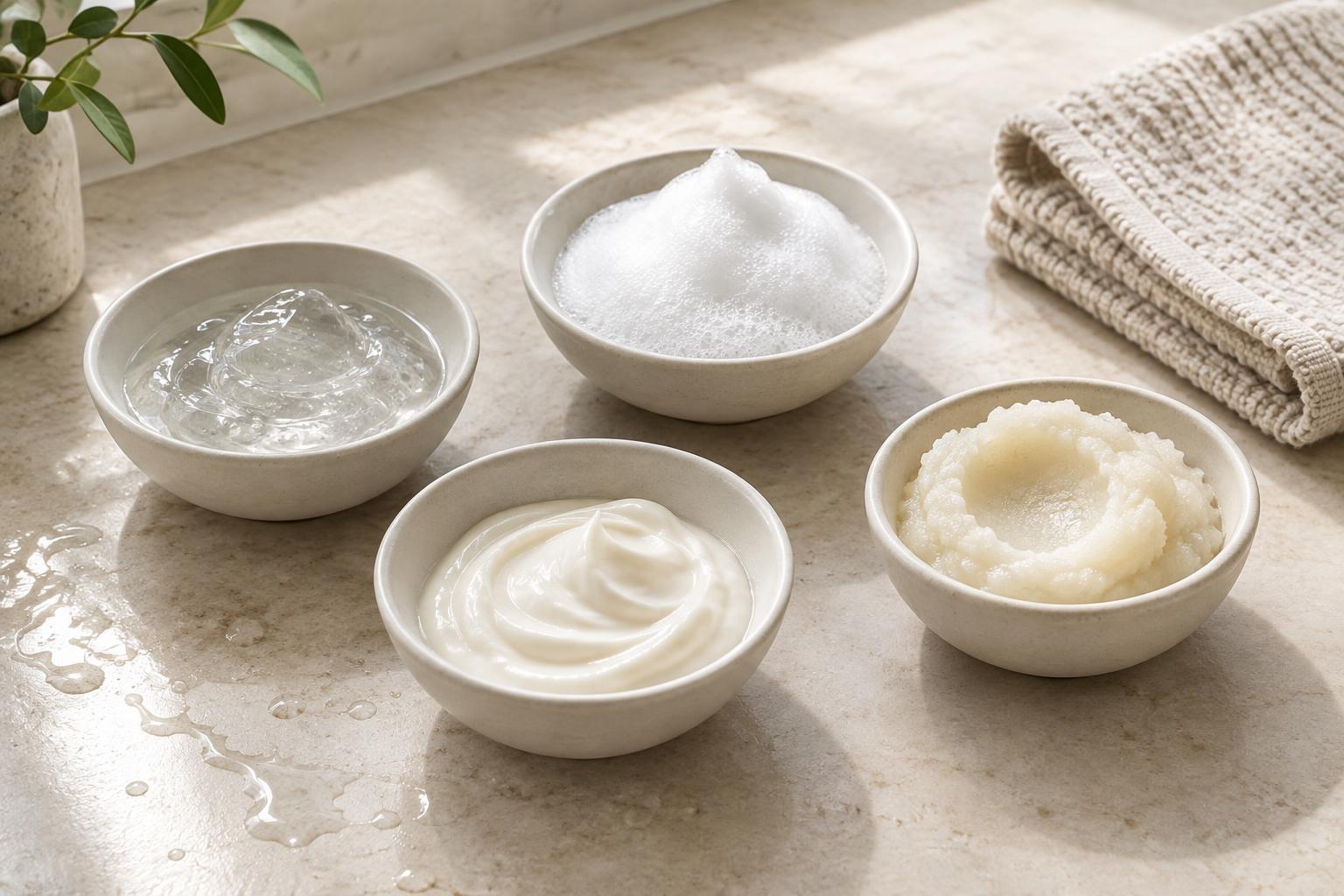
Gel cleansers usually have a clear or translucent, slippery consistency. Many spread easily over damp skin and rinse away without much of a coating. Some create bubbles; others produce little visible lather. A gel can feel appealing if you prefer a quick rinse and a relatively bare-skin finish, but the word “gel” alone does not tell you whether it will feel gentle or drying.
Foam cleansers are designed to produce an airy lather. Some leave the container as foam, while others start as a liquid or gel and foam up when mixed with water. The bubbles can make the cleanser easy to distribute, but foam itself is not a measure of cleaning power. Nor does a high-lather cleanser automatically clean better than a low-lather one. Pay attention to the result: skin need not feel tight or squeaky to be clean.
Cream and balm: richer ways to cleanse
Cream cleansers tend to be opaque, smooth and lotion-like. They often produce little foam and may feel cushioned while you massage them over the skin. Some rinse clean; others leave a softer-feeling finish. That finish can be pleasant if a light, foaming wash feels uncomfortable, though it does not necessarily mean the cream has left behind enough moisture to replace your usual moisturizer.
Balm cleansers are typically thick in the container and soften as you work them between your fingers or over the face. Their oily feel can help loosen makeup and water-resistant products. Many balms contain ingredients that let the product turn milky when water is added, making it easier to rinse away. Others may need more wiping or a follow-up wash. Follow the product’s directions rather than assuming every balm behaves the same way, and avoid vigorous rubbing around the eyes.
How to choose for your everyday routine
Start with what you are trying to remove. For a simple morning cleanse, a light gel or cream may feel convenient; depending on your preferences, rinsing with water may also be enough. At the end of a day with makeup or water-resistant sunscreen, you might prefer a balm first, or a single cleanser that removes what you wore without repeated scrubbing. A second cleanse is an option, not a rule. If the first wash removes the product comfortably, another may add little to your routine.
Then consider the after-feel you enjoy. If your face regularly feels tight after washing, try using less product, washing for less time or switching to a different formula. If a cleanser seems to leave more of a film than you like, try a more readily rinsed option. These observations are more useful than treating “gel” as a match for one skin type and “cream” as a match for another.
Temperature and technique also affect the experience. Use water that feels comfortable rather than very hot, and let the cleanser do the work with gentle fingertip movements. Rinse according to the label and pat dry. If you use moisturizer, applying it after cleansing helps complete the routine; a cleanser is designed mainly to wash off, however rich it feels.
Reading beyond the name on the bottle
Product descriptions can help narrow the field, but terms such as “deep clean,” “gentle” and “hydrating” do not describe a standardized texture or guarantee an outcome. Check whether the cleanser is meant for use on damp or dry skin, whether it should be rinsed or wiped off, and whether it is intended to remove makeup. Those details can tell you more about how it fits your routine than the front label alone.
If you are comparing unfamiliar products, change one cleanser at a time and notice how easy it is to use, how thoroughly it removes what you wear, and how your skin feels afterward. There is no universally best texture. The best practical choice is one that cleans to your satisfaction without making the washing step feel like a struggle.