What pH means in a cosmetic formula
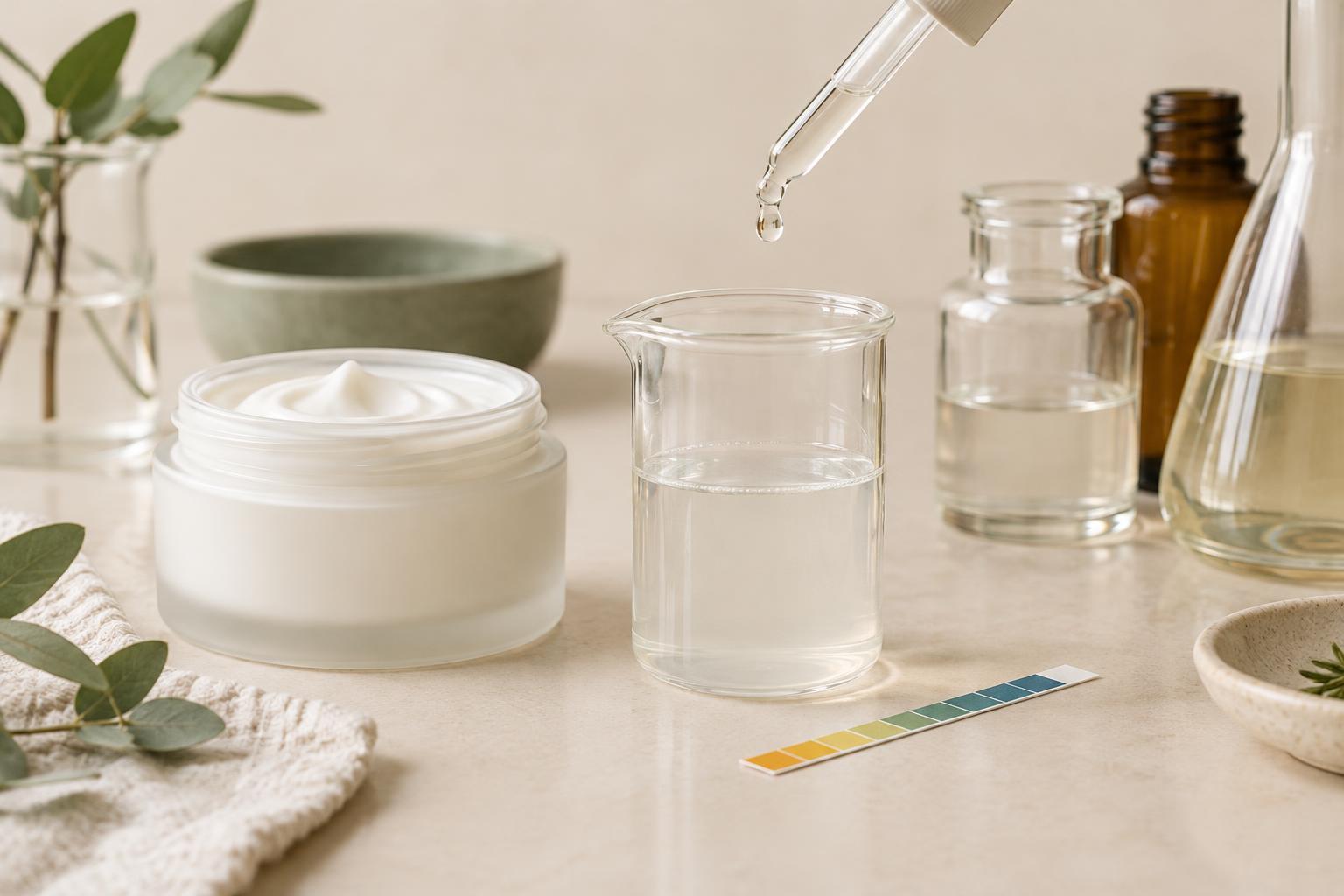
pH describes how acidic or alkaline a water-based solution is. On the familiar pH scale, 7 is neutral, values below 7 are acidic, and values above 7 are alkaline. In cosmetics, pH is relevant mainly to formulas that contain water, such as cleansers, lotions and many serums. An oil or balm with no water does not have a directly comparable pH in the way a water-based product does.
A formula’s pH is not determined by one ingredient alone. Water, cleansing agents, thickeners, preservatives and other components can all affect the finished mixture. Formulators therefore check the product as a whole and may adjust it toward a range that suits the formula’s ingredients and intended use. That range is not the same for every type of product.
What pH adjusters do
A pH adjuster is an ingredient used to move a formula’s pH up or down. Citric acid and lactic acid may be used to lower pH; sodium hydroxide may be used to raise it. The amount added for this purpose can be small, and its role depends on the complete formula. Seeing an acid on an ingredient list does not, by itself, mean the product is designed to exfoliate.
The names of pH adjusters can sound more dramatic than their function in a finished cosmetic. Sodium hydroxide, for example, is strongly alkaline on its own, but that does not tell you the pH of a lotion in which it was used to balance other ingredients. Likewise, a product containing citric acid is not necessarily very acidic. The finished product’s pH depends on the combination and amounts of ingredients, not just the presence of a familiar name.
How buffers help a formula hold its pH
Adjusting pH sets a starting point; buffering helps resist changes away from that point. A buffer typically pairs a weak acid with a related ingredient that can help absorb small shifts toward greater acidity or alkalinity. Citric acid and sodium citrate are one possible pairing. Not every formula needs a buffer, but one can be useful when keeping pH within a particular range matters.
A buffer does not lock a product at one exact number. Large changes to the formula can still alter its pH. Rather, it gives the formula some capacity to withstand smaller changes that might otherwise affect how it performs. The relevant question for a formulator is not whether a product contains a buffer, but whether its pH remains suitable over the product’s intended use and shelf life.
Why the target pH matters
Different ingredients work best under different conditions. The performance of some preservatives, for instance, depends in part on pH. Certain thickeners and cleansing systems can also change in texture or behavior when pH moves outside the range for which they were formulated. Keeping pH in an appropriate range can therefore support a product’s consistency, stability and preservation strategy. It does not, on its own, prove that a product is effective or adequately preserved.
pH can also influence how a product feels during use, though it is only one factor among many. A cleanser’s surfactants, concentration and contact time matter too. Claims that every skincare product must match one precise “skin pH” oversimplify the subject. A rinse-off cleanser and a leave-on moisturizer have different uses, and their formulas may reasonably be designed for different pH ranges.
What you can learn from the label
An ingredient list may show likely pH adjusters or buffer components, but it usually cannot reveal the finished product’s pH. The same ingredient can serve more than one purpose, and the list does not tell you exactly how much was used or how the ingredients interact. Terms such as “pH balanced” may describe a formulation goal, but without a stated range they offer limited detail.
If pH is important to you, look for a clearly stated value or range from the product maker, while remembering that pH is only one part of evaluating a cosmetic. For everyday choices, the more useful questions are whether the product suits its intended step in your routine, feels comfortable to use and delivers the cosmetic qualities you want. pH adjusters and buffers are tools that help formulators make that possible—not ingredients that are inherently good or bad on a label.